Roseola rash: Pictures, symptoms, and treatments - Medical News Today
Roseola infantum is an infection caused by a type of herpes virus. It typically affects babies and toddlers.
Other names for this health issue are sixth disease, exanthema subitum, or just "roseola."
Roseola results from infection with one of two main strains of the human herpesvirus (HHV): HHV-6 or HHV-7.
Below, we describe how to identify roseola and how to tell the difference between it and measles. We also look into whether treatment is necessary.
Roseola has a
- A high fever develops, possibly suddenly, and may last for 3–5 days.
- A distinctive rash appears, usually on the torso, as the fever ends.
- The rash may spread to the neck, face, and limbs within 24 hours.
- The rash disappears after 1–2 days.
Roseola usually affects toddlers and babies under
- general discomfort
- irritability
- an unwillingness to eat
- diarrhea
- a cough
- swelling or redness around the eyes
- inflamed eardrums
- swollen lymph nodes
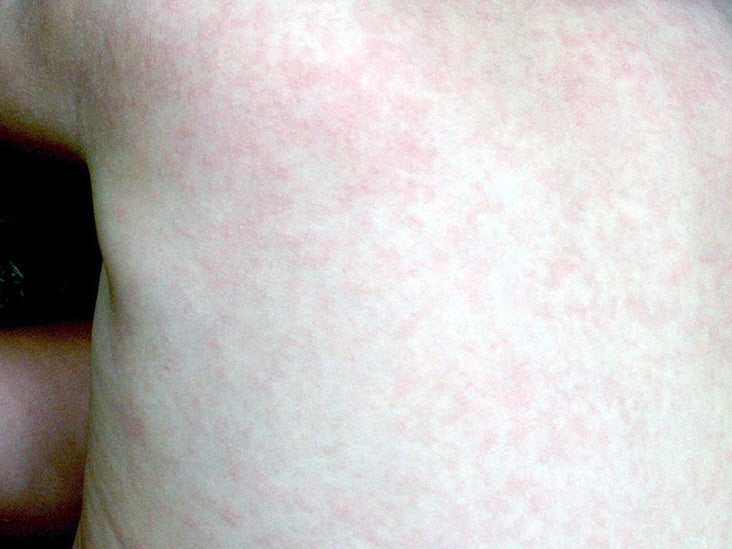
The roseola rash may look like a raised, flat area of skin. Or, it may be raised patches of flat bumps that may merge together.
In some babies, the rash is reddish, and it may turn a lighter color when a person applies pressure. There can sometimes be a paler "halo" around the rash area.
The roseola rash does not usually cause pain, itchiness, or any blistering. It usually starts on the trunk of the body and can sometimes spread to the neck, face, arms, and legs.
About
Roseola and measles both cause rashes and are common during childhood.
Measles can develop at any age, however, while roseola rarely affects adults. Find other important differences below.
Cause
Two strains of the herpes virus,
The virus
Measles, or rubeola, results from the
Rash appearance
The roseola rash
Children with measles, on the other hand, usually have a
Complications
Children with roseola usually recover with
However, a high fever can be a common symptom of roseola, and it causes seizures in 10–15% of cases. This is the most common complication of the infection.
It is also worth noting that babies and toddlers with weakened immune systems tend to experience more severe symptoms of this infection.
Also, the virus
Also, HHV-6 infection has been
People with measles often recover with
The risk of complications is higher in children and babies under 5.
Prevention
There is currently no vaccine for roseola.
Measles, meanwhile, is a
There is
Do not use aspirin without contacting a doctor, as it may cause Reye's syndrome in children, which can be deadly.
It is important to let the baby rest and make sure that they receive plenty of fluids. It is important to follow good hygiene, such as by washing the hands frequently, to prevent the infection from spreading.
It is important to seek medical attention right away if a baby has a high fever, a persistent rash, or both.
If there are signs of a febrile seizure — a seizure brought on by a high fever — seek immediate care.
Signs of a febrile seizure include:
- moaning
- rolling eyes
- vomiting or urinating
- convulsing, shaking, or twitching
- losing consciousness
A doctor can diagnose roseola by checking for symptoms and considering their medical history. They may also use a blood test to support the diagnosis.
Anyone with a compromised immune system who comes into contact with a child who has roseola should receive medical advice.
Roseola is an infection that typically affects babies and toddlers. It causes a high fever that lasts for 3–5 days, then a rash for a day or two. There is no specific treatment or vaccine.
The rash is very distinct, and it spreads in a characteristic pattern, starting from the torso.
Usually, roseola will resolve within about a week. An age-appropriate dosage of ibuprofen (Advil) or acetaminophen (Tylenol) can usually reduce the fever.

Comments
Post a Comment